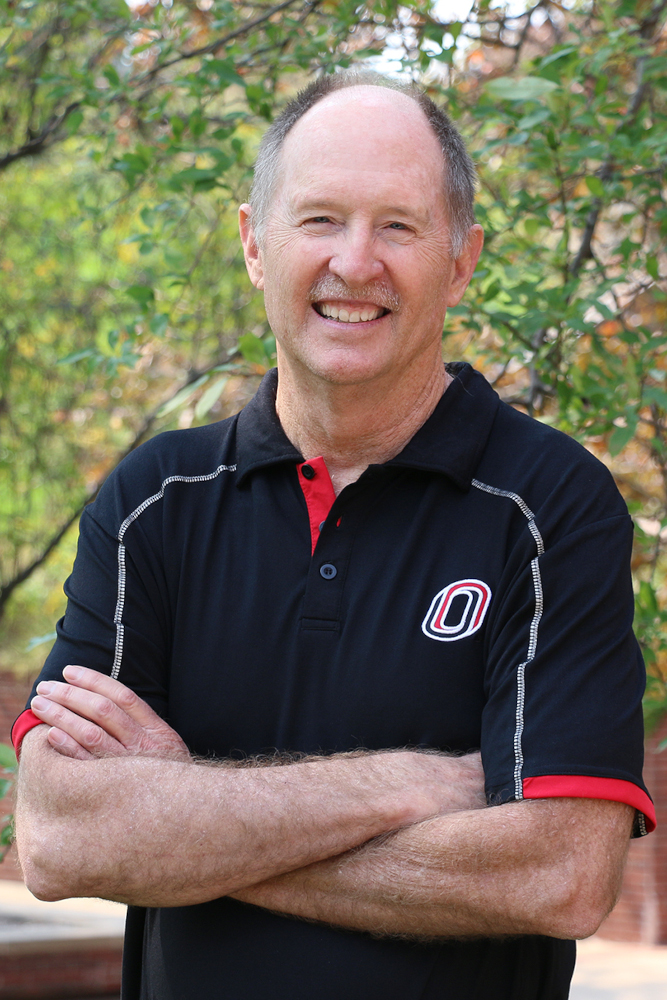
I was born in Omaha, of two loving parents who were educators, and my father, Don was an OPS Junior High School science teacher (eventually a UNO faculty member), and my mother (Jean) was a 2nd grade schoolteacher in the Catholic Archdiocese. I have two brothers and one sister, who each also graduated from Burke. While at Burke, I was an average and somewhat challenging student, but I loved all the teachers and courses at Burke and took one of the very first high school “computer courses” offered in the district (and in the country). That very rudimentary programming course initiated a lifelong interest in me for studying mathematics, science and technology, and their many applications, as it all came together for me in that one course.
I graduated in 1976 from Burke, and immediately joined the United States Marine Corps, where I served a tour of duty and eventually rose to the rank of Sergeant within a Marine Barrack’s security unit stationed primarily at Concord Naval Weapons Station in California. My computer experience at Burke also helped me to eventually be designated within the base as one of the Corp’s first users of the military’s manpower management systems, as I was also one of the only marines with basic computer experience at the time (thanks to Burke). During the Marine Corps, I also became very interested in studying the martial arts and eventually received a fourth-degree black belt in Tae Kwon Do and became a certified instructor, teaching both adults and children for many years later. After serving honorably in the Marine Corps, I used the GI Bill to attend UNO, and to study and to become a middle school mathematics teacher.
During my middle school teaching of mathematics for the Westside Community Schools, I received a master’s degree in mathematics education at UNO, and married my wife, Ann, who has now been married to me for 38 years, and who is also an OPS alumnus from Northwest High School. Ann and I also have three children, Nicholas, Hanna, and Emily, who all graduated from Benson High School in OPS. Nick is an immigration lawyer for Appleseed, Hanna is a clinical mental health assistant professor at UNMC’s Monroe Myer Institute, and Emily is a Nurse Practitioner. Each of our three children all frequently mention how much of a life advantage that they had growing up in and going to school at Benson, and the highly kind and supportive environment of OPS, where every student’s background and culture is so richly honored.
Eventually I was offered a full-time instructional technology instructor position at Iowa State University, where I also worked on a Ph.D. in Curriculum and Instruction, and ran the ISU College of Education’s instructional computing laboratory as well as taught preservice teachers how to use computers within their instruction. I graduated from ISU in 1989, and I was offered a job in the UNO College of Education as an Assistant Professor in Mathematics Education.
At UNO, I also had the significant pleasure to serve with my father, and who had already become a UNO professor there in teacher education nearly two decades earlier. My father and I would frequently attend campus meetings together, and some of my memories of him as colleagues are some of the most special ones that I have now, as I was able to see Dad as both a friend and an impressive educator, and as one of the most effective teachers on UNO’s campus.
Eventually, I rose through the UNO faculty ranks from Assistant Professor to Associate Professor and then eventually to Professor. I was particularly interested in a new area called “STEM Education” and where I eventually wrote 180 peer-reviewed publications and received $24M in external grants across five divisions of the National Science Foundation, often working with area school districts, including OPS. Over the years, I taught a total of 202 undergraduate and graduate courses as a UNO faculty member, and designed courses around data informed decision making, STEM education, and educational research. I eventually was given the first Community Chair designation at UNO, which was called the “Dr. George and Sally Haddix Community Chair of STEM Education” and where I led UNO’s STEM initiatives, including co-developing UNO’s STEM Teaching, Research, and Inquiry-based Learning Center, now commonly called now the STEM TRAIL Center, which continues to be a hub of campus STEM efforts today. I eventually won various UNO awards for my STEM work, including the UNO Distinguished Research and Creativity Award, the NU Outstanding Teaching and Instructional Creative Activity Award, and the UNO Chancellor’s Medal.
Eventually, I was asked to assume the role of Associate Dean, which I was for two years before being asked to assume the role of Interim Dean, after the retirement of Dean Nancy Edick. I was encouraged to run for Dean by the faculty, and in 2024, I became the Lois. G. Roskens Dean of the College of Education, Health, and Human Sciences and I currently serve in that role today. Our college has 108 full time faculty and 34 staff members across six units, including the UNO Departments of Teacher Education, Educational Leadership, Counseling, Biomechanics, and Special Education and Communication Disorders, as well as the School of Health and Kinesiology. Each of our six different units have considerable initiatives underway with area school districts, and particularly OPS. I have asked faculty in each of these six units to prioritize their work with schools by first listening to what these educational colleagues want, and to increasingly participate on their school’s advisory boards, to aggressively support their innovative work, and to be engaged in their various joint efforts where a UNO partner might be helpful.
Finally, in closing, let me say that I was both surprised and incredibly humbled to receive this honor from Burke. While you won’t find my name on any school records or awards, please know that my high school graduation in itself was a significant “group achievement” at Burke, as many teachers and administrators provided extra help, extra kindness, and significant patience, to support what might have been seen by lesser educators as someone without much drive or potential, including with average grades, below average athletic ability, a bit of a quick temper, and often a very quiet student to have in a class. I especially had some behavioral challenges outside of class and got into a few fights with other students, and I had frequent conversations while at Burke with the past Dean of Students, Mr. James Craigmile, after being sent to his office frequently. He eventually became one of my strongest advocates, an important friend, and along with my father and mother, a key role model in leadership. This, it is important to know that for all those years from 1976 until today, I took much of what I learned in the kindness, positivity, and patience from Mr. Craigmile and many others at Burke and applied it into my own educational career and educational leadership. So, by honoring me today, please know that you also honor Mr. Craigmile, and those many teachers and administrators at Burke over the years, both in the past and today, who look past the challenges that students are experiencing in the moment, saw beyond those, and gave those students extra kindness, support and patience, and the opportunity to know that they are still worth the effort given freely by them to help that student become something very special, if just given the chance, and perhaps well into the future when they won’t even know how the personal story evolves or ends. So, thank you so much Burke friends, as you indeed gave me that chance and to help my story to be a positive one!